
News From Omena, July 1857
Letter to Walter Lowrie from Peter Dougherty, Grove Hill, 17 July, 1857
Transcription and commentary by Mark Smith, secretary, OHS
• In which we learn that Reverend Dougherty is ready to sever ties with the Presbyterian Board unless something can be done about Mr. Porter. •
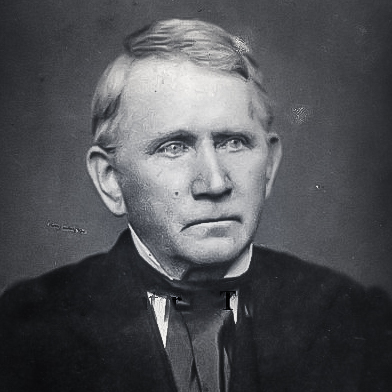
Reverend Peter Dougherty
In a previous post, News from Omena, January 1855, we learned of the hardships and challenges Reverend Peter Dougherty faced in organizing and running Grove Hill School, Dougherty’s residential school for Native Americans. This 1857 letter from Peter Dougherty to Walter Lowrie, corresponding secretary of the Presbyterian Board of Foreign Missions, comes a little over two years later and chronicles the infighting between Reverend Dougherty and John Porter over the running of the school.
In Reverend Dougherty’s introductory paragraph he praises Miss W. A. Isbell, Teacher of Female Department, and bemoans her imminent loss due to her heavy work load and low pay. This would be a recurring theme in Dougherty’s letters to Lowrie: the difficulty in recruiting and retaining good staff.
In the second paragraph Dougherty begins to come to the point: he wishes for the Board to change the terms of his employment or to discontinue employing him. As the letter goes on the source of this ultimatum becomes clear. At first Dougherty asks for more family time, which means a manse for his family to call their own, a place away from the daily running of the institution (where they currently lived). He also wants to be freed from the running of the school so that he may concentrate more fully on his pastoral duties as a minister to a wider flock. But really, these wishes are merely the preamble for his main complaint.
Paragraph three bluntly introduces the main source of Dougherty’s dissatisfaction: “I supposed from your letters to me that I was considered in charge here and was responsible for the proper management of the institution.” This is a delicate matter which Dougherty confronts head on. Who is in charge of this school, me or Mr. Porter? It is really quite bluntly put. To complicate matters further, it must be mentioned that John Porter, Teacher of Male Department, was a nephew to Andrew Porter, who was with Dougherty on Old Mission before being sent to Bear Creek (Petoskey) in 1852 to start a mission there. Andrew was Walter Lowrie’s nephew and John was Andrew’s nephew. John Porter arrived on the scene at New Mission in 1854.
Porter claims to have the “right of the entire control of the boys” and does not acknowledge Dougherty as his superior. Dougherty makes his contempt of Mr. Porter clear, indicating that Porter is not really interested in the hard work of the school (“he got some what tired of the school and found the confinement oppressive”), and that Porter has vowed never to go back inside the school again, instead now to be in charge of outdoor work, for which, according to Dougherty, Porter acknowledges no superintendence (“you are not the boss of me,” in other words). Dougherty then relinquishes any responsibility for the outdoor work.
In paragraph four we learn that Mr. Porter has been working as Deputy Surveyor for the county. This job takes him far afield and leaves the rest of the staff short-handed. The job of surveyor paid $3 per day, which was more than could be earned at the mission. Mr. Joseph Glenn, farmer, and George Craker, assistant, are both of the opinion that Porter’s frequent absences are “unfair”, and in fact George would have left by now (writes Dougherty), had it not been for assurances on Mr. Porter’s part that he would give up surveying. But Mr. Porter did not give up surveying. In fact, Porter seems to have been in direct communication with Walter Lowrie and it seems as if Walter Lowrie has told Porter that he does not need to account for his time, and that his pay at the mission would not be docked when Porter was out surveying: “He [Porter] said when he left the institution he intended to report the time thus lost, but that you had written to him he need not make any account of time thus lost.” In finishing Dougherty softens his criticism somewhat (“I may have wrong views on the matter”) but still manages to imply that Mr. Porter does not really care about his job at the Mission.
The last part of Dougherty’s letter thanks the Board for all its many kindnesses, before circling back to Dougherty’s initial request to be relieved of the duties of running the institution (the school), in favor of just being a minister, which is already enough. Dougherty seems to be laying down a marker for the Board. He wants a house for his family and he wants nothing more to do with the school.
It would not be until 1862 that George Craker was appointed Mission Farmer, replacing John Porter. Mr. Porter and family settled in Leland township and remained, and Porter continued surveying at least as late as 1884. Mr. Dougherty remained as superintendent and eventually built a house for himself and his family at his own expense, remaining in Omena until the mission is discontinued in 1871.
To sum up, in this 1857 letter from Reverend Dougherty we witness the cauldron of petty rivalries and slights which made the running of Grove Hill School even more difficult than it might have already been. And here is another thing to consider .. John Porter’s wife, Annis McElvain, was Mary McConnell’s sister. Mary (McElvain) McConnell, cook and laundress at the school, was later married to George Craker, who was nine years younger than her. In other words, in addition to John Porter’s relationship to Walter Lowrie, other relationships also determined the fault lines of daily relations at the school. It wasn’t just the weather, the isolation, and the physical challenges of survival that made the job hard. It was also infighting. In fact, the infighting almost led to the closing of the school in 1857, when Reverend Peter Dougherty officially expressed his wish to be relieved of the burden of running it.
But he stayed on. He worked it out. He persevered for the good of his flock.
And this is why primary sources are so fascinating and so important. In the letters of Reverend Dougherty we see a man frustrated with the complications and hardships of his life NOW, not merely the summation of a life well-lived. There was nothing pre-ordained in his success. Fortunately Reverend Dougherty found a way through the crisis and continued his mission to the Native Americans, otherwise we would have no story to tell at all. By the end of 1858, with the assistance of the Presbyterian Board of Foreign Missions, Reverend Dougherty would supervise the building of both a new manse and a new church in Omena.
Thanks to Marsha Buehler, Archives and Exhibit Committee Chair, for help with background biographical info and advice
Here is the letter, and below is the transcription.
•••••••••••••••••••••••••••
Walter Lowrie, Esq.
Grove Hill, July 17th, 1857
Dear Sir
I have our vouchers ready which I will forward with this, with a report of expenses. Miss Isbell would prefer if you would forward her salary to her friends in New Haven. The amt. of her bill her a [?] $19.13. She still complains of her hard service and says she can’t continue to do it another winter. After you wrote to me I saw her and the matter was talked over among the females and Mrs. McConnell assisted her for a time, why she did not continue or whether she will resume I have not learned. Miss Isbell is most industrious, takes good care of the girls, their clothing too, and deserves great praise for the time and labor she gives to them but others may feel that her plans impose more labor than is necessary. All are quite well – the school is going on regularly, not as full as last winter. Our supplies came the 15th. The season has been cold and backward but is now warm growing weather. Our wheat is fair and will if saved nearly furnish our bread for the next year.
After much reflection I feel it a duty to myself and family to signify my wish to have my relation with the board changed, either to have my relation discontinued or so changed that I can live out of the building. It is necessary to have early hours for family work and meals, which imposes on females and small children very early rising or to grow up without even the form of devotion. So with breakfast small children have to be furnished with meals out of time which interferes with the regular work of the dining room & kitchen. Again – with my time occupied as it is every day I find scarcely any time to instruct or take care of my children. Besides these things and the feeling that the members of the church and families here are neglected there are certain things here which I am not satisfied with and which brings me in collision with others and makes me feel I would rather withdraw and let others take the management of the institution.
I supposed from your letters to me that I was considered in charge here and was responsible for the proper management of the institution. After Mr. Porter came we consulted together and agreed on some rules by which the children should be governed. These rules were disregarded and he claimed to have the right of the entire control of the boys, that he had no instruction that there was to be any Superintendence and he did not acknowledge any. As to his management of the boys I say nothing further than I disapproved of it. After he got some what tired of the school and found the confinement oppressive and I became disabled and proposed to take the school he said he would not go in the school again but would take the outdoor work as I wrote to you. After entering in these duties he claimed the same independence he had in the school and told me as to the office of Superintendent he did not know how I had it unless you saw me exercising it & gave me the title because I had assumed the office as there was no Superintendent in other missions. I then relinquished all those matters to him and do not wished [sic] to be considered as responsible any further for out door matters.
The chief source of dissatisfaction with him has been his claiming and exercising the right of leaving the business of the mission to do frequent jobs of surveying. He has accepted the office Deputy Surveyor of the county. He has frequent calls to survey roads, village plots and lots of land from six to twenty miles distant. His doing so produces dissatisfaction. Mr. Glenn spoke of it as unfair and George this spring would have left on this account when the took charge of the farm if I had not persuaded him to remain and Mr. Porter told him he would give up surveying. I do not think it fair that one should have the right to drop the business of the mission and hiring out at $3 per day while others have to devote all their time to the institution, even if a substitute should be hired but when I suggested that it would be but right to allow the time, thus taken, to that and as much extra help had to be hired. He said when he left the institution he intended to report the time thus lost but that that you had written to him he need not make any account of time thus lost. I may have wrong views of this matter but with my views I do not feel well to have matters go so and others dissatisfied and complaining, causing them to feel if those who are regarded as heads here can neglect the interests of the mission for private gain they do not much care how matters go.
These are in a sense little matters but they cause irritation and lead me to the decision to separate myself from the institution and when freed from the responsibility I will not feel constrained to interfere, and those little heart burnings will be avoided.
With regard to the board, we are entirely satisfied and feel grateful for all the kindness we have experienced. My conviction is that duty calls for more time to be devoted to the members of the church and families about here. I do not see a clear indication to leave these people unless the Board do not feel able to sustain a missionary separate from the school. I do not think it would cause as much additional expense as you named if you can get a suitable man with a small family. I make this statement now that you may have time to consider the matter & secure some one – and if I go out of the institution and remain, I may make some arrangements for a place for my family to live.
Mr & Mrs. Beatty were at North Port last Saturday but the boat left before we got there so we did not see them.
Respectfully yours
P. Dougherty

 Attached to Colonel DeLand’s First Michigan Sharpshooters was a company of civilized Indians who won fame at Spottsylvania. On that bloody 9th of May, 1864, the Federal line, advancing with a cheer, met the charging enemy in a dense thicket of pines, and in the hand-to-hand struggle that followed, the Union forces were slowly forced back. The First Michigan Sharpshooters was doing its best to hold the ground. Every now and then the Confederates would fight their way up to the battery and lay hold of the cannon to turn them upon the Union forces. But to touch one of those guns meant instant death at the hands of the sharpshooters. In this desperate encounter, the little band of Indians was commanded by Lieutenant Graveraet…. Under a perfect storm of lead their number seemed to melt away, but there was no sign of faltering. Sheltering behind trees, they poured volley after volley at the zealous foe, and above the din of battle their war-whoop rang out with every volley. At dusk the ammunition gave out, but with the others the Indians ran forward at the shout of “Give them steel boys!” from the twice wounded but still plucky Colonel Deland.


