A Tedious Day

A Tedious Day

From Miriam Webster:
Tedious has been in use since the 15th century and has been included in hundreds of dictionaries, although perhaps none have rendered so poetic and succinct a definition as Nathaniel Bailey’s entry in his 1756 *New Universal Etymological English Dictionary*: “Wearisome by continuance.”

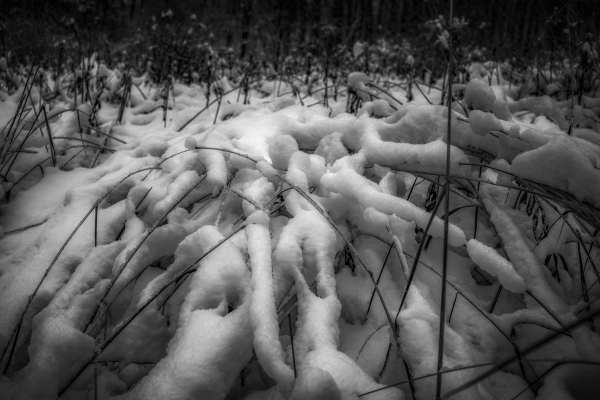
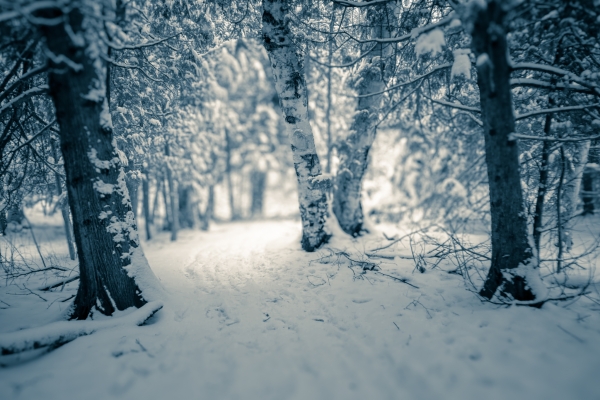
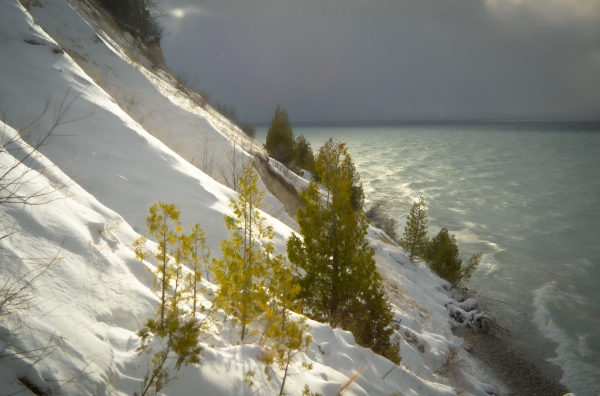
It’s January in Leelanau County and we are in the grip of a major winter storm, with temperatures hovering around zero degrees and winds howling. Schools are closed and we sit indoors and look out, grateful that we are warm and safe. On days like this Reverend Smith of Northport would be housebound, stoking fires, keeping warm, having church meetings when possible. Of course, the animals still needed tending. Imagine the challenges of getting water to your horses and cattle when the wind howls, the snow drifts, and the temperature plummets. It would involve buckets and hand pumps, gloves and boots, and digging snow to even reach the barn (no snowblower involved):

Jan 1st 1864 Mer 0°8°14 16o Wind W a most furious gale Snow drifting so that we can scarcely see & piled up in great banks every where so it is almost impossible to get out door any where it is probably 4 feet all around our West door, the window nearby banked up! I have been 3 to Mary’s [his daughter, up the hill] by wallowing thro the banks. Carried some fresh beef, onions &c it is a fearful time I think I never knew so severe a day thus begins the New Year

Jan 3nd, Sunday, -3°, Wind N, Cloudy furiously tempestuous snow drifting fearfully no possibility of getting away any where. There has been no meeting in this place today I was quite sick through the night & fore part of today, feel better tonight. I can’t get a horse from the barn to the house have had to carry water to them over the drifts I had to shovel a long time to get my pigs out so I could give them drink this is the 3d day since they had any they were literally buried.  One of our roosters froze to death today others almost failed it is altogether the worst storm and of the longest continuance I remember ever to have known

January 28, 1867, Mer 15°19°11°Wind NW light
Eve strong – cloudy – some snow squalls I have most of the day been engaged in shoveling away from our doors — it is a very hard job I have also shoveled out one gate but have not yet shoveled a road to the barn – so can’t get a horse out yet –
February 4, 1868 Mer 14° Shoveled out doors, gates etc. it is wearisome work

Winters were colder then. People kept root crops in their cellars to avoid the freezing temperatures, and brought them upstairs as needed. But after days and weeks of bitter cold, even the cellars would freeze, rendering potatoes, carrots and turnips into frozen pulp and threatening ruin and starvation:
January 23, 1871, 8°
Tedious day – our cellar froze last night some

Regular commerce was interrupted. People risked life and limb just to travel from place to place. When it got dark outside, it was very dark indeed:
Sab Jan 10, 1864, 15°
We walk over the top of our picket fence on Snow drifts. PM I shoveled out the N gate so I could get out with my horse & cutter – I started to H.H. [Head of Harbor, ie. The Bight] but met Mr Rose. He said it was impossible to get through, the road was completly blocked up – Mr Woolsey tried to get through with oxen & sled last night with Mrs Woolsey – got into a. snow bank & had to leave his sled & go home on foot I never have seen such a time since I have been in the country
Dec 15, 1851 Mer 6 A.M. 6°/ 5-P.M. 10°
Snow has fallen since Thursday in occasional & frequent squalls 7-inches. It still snows. W. Case & John Baptist started for Manistee to trade for Mr. Paul. J Lerue Dr to 1/2 Bushel Turnips -/ to 1 Raccoon Skin—0,50 Cr by Razor 6/ Strap 4/ 1,25/ 1 Ball Wicking 1 pencil 0,06/ 1 Paper tacks 0,06
It still Snows & blows/ hard night & day — it is a very tedious time

And always the word from Reverend Smith was “tedious”:
Jan 22, 1855 -Mer 14°-12°-7°-Wind NW,
One of the most tedious blows I ever knew last night it was almost enough to make the earth tremble snow also fell fast in all about 6 inches

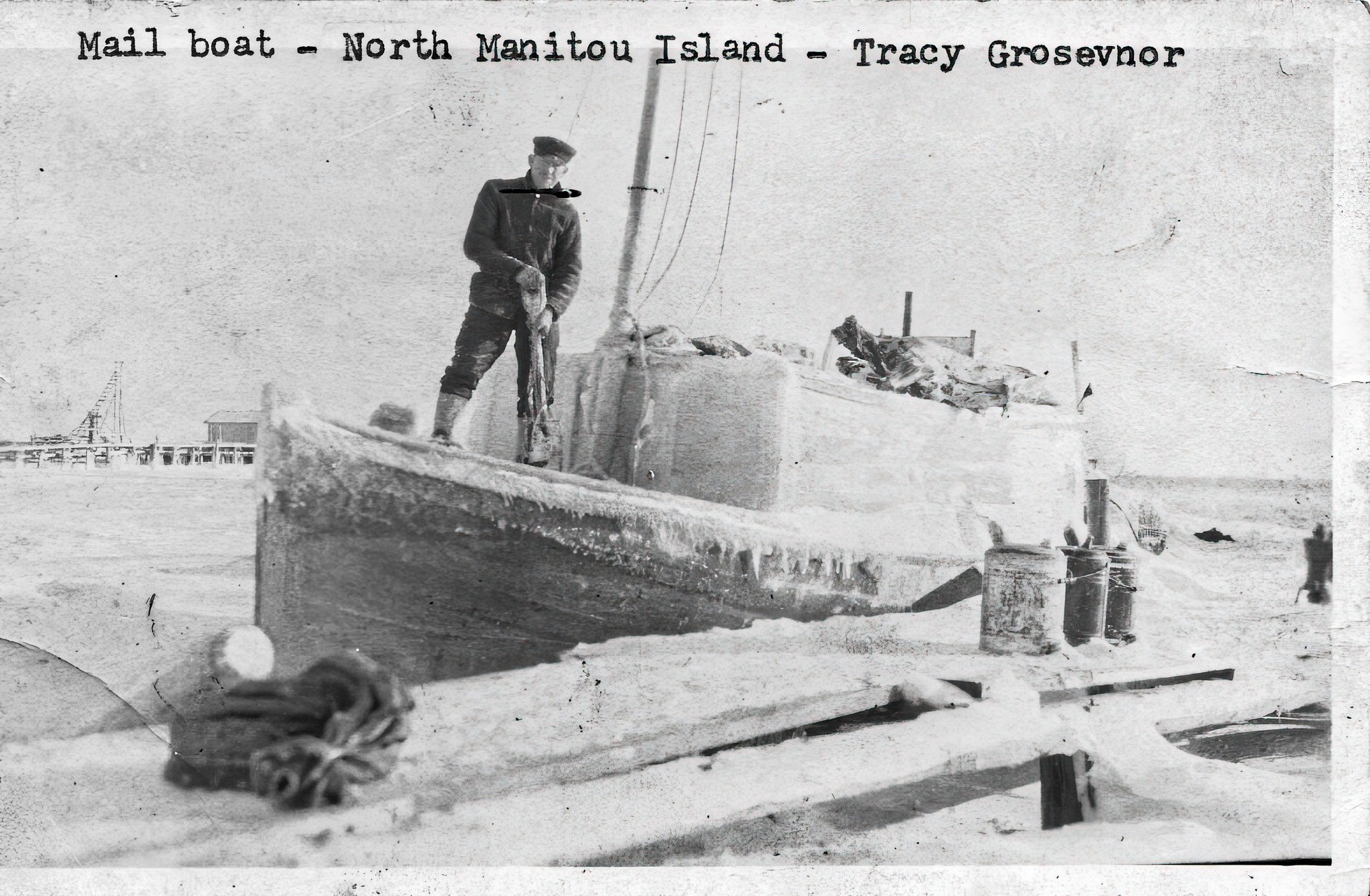
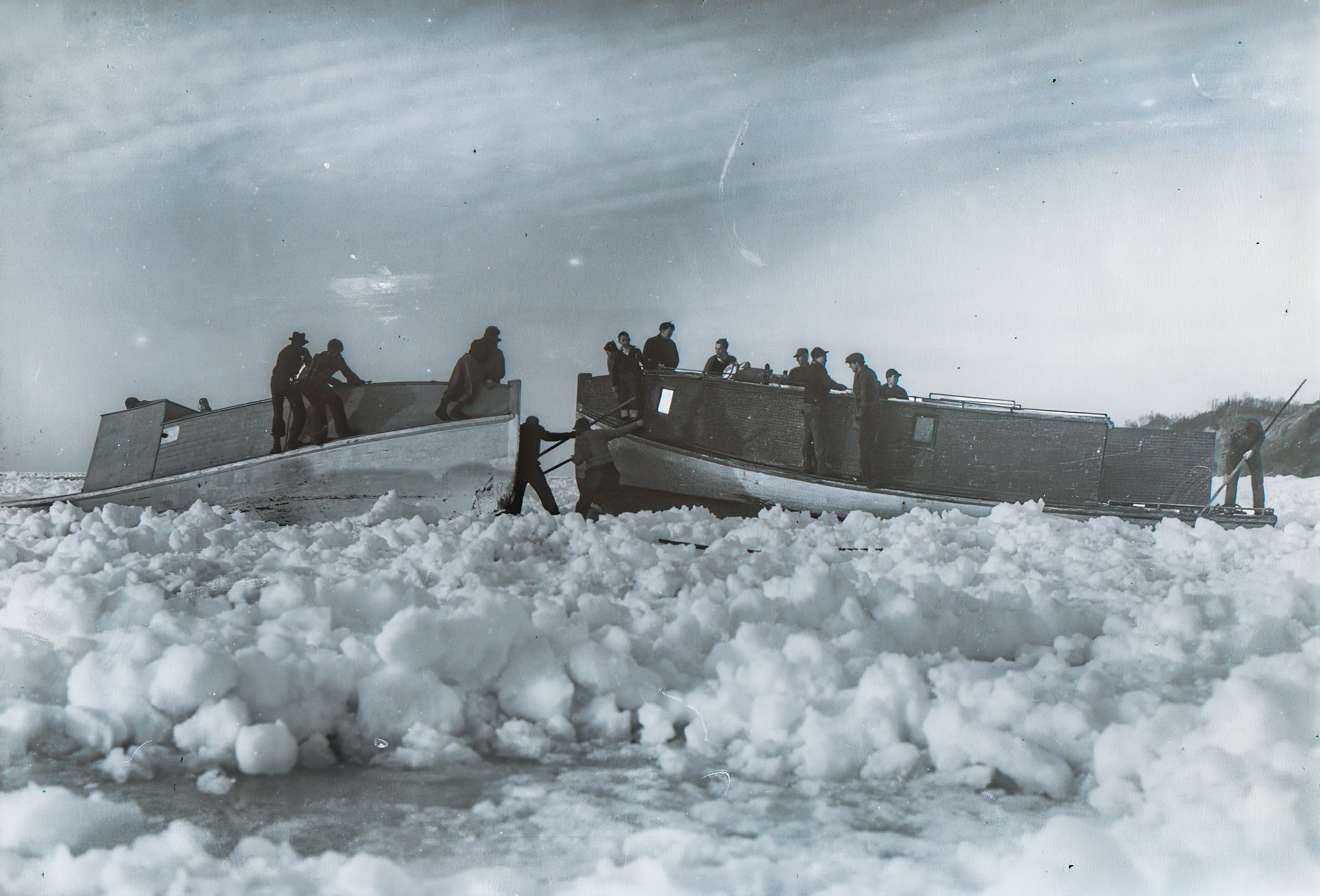
Winters were colder then. Ice always formed on the bay, unlike now. In fact, the winter was the best time to haul wood from the Manitou Islands because the lake always froze all the way out, allowing teams of horses to cross over. The ice became a highway for commerce. A story told by George Grosvenor relates how his dad, Tracy, had the Mail contract to North Manitou Island. Normally the mail boat was used, but in  the wintertime when Lake Michigan froze they would drive their model A or model T out to the island with George carrying a two by four, walking ahead to test the ice, and tied to the front bumper. One hopes that young George was able to slip free of his two by four harness in the event of the car going through the ice behind him.

Winters were colder then. And remember, there was no internet, no tv, no radio, no telegraph … nothing. News from the outside world came slowly and getting out to see your neighbors became impossible. Getting out to use the outdoor toilet would be equally impossible, so let your imagination work on that. Even basic hygiene became a challenge (no toilet paper!). And sickness was never far away (no kleenex!). Long days spent indoors, near the fire, reading by lamplight or by sitting next to one of the small windows which graced the house. Frequent forays outside to keep the animals alive. Writing in journals, bringing in wood, tending the fire, drawing water, keeping warm. These were the necessary and restricted activities which made up the typical day of Reverend George Nelson Smith (1807 – 1881) in early Northport, at the edge of the known world. These were the days of tedium.

by Mark Smith, OHS secretary

The diaries of Reverend George Nelson Smith can be found here, hosted by Northport Area Museum
Photos of the Manitou Mail Boat, courtesy of Leelanau Historical Society

Place of the Cleared Land: True Origin of the Name “Michigan”

by Dustin Bissell and Eliot A. Singer

(click here to read the essay by Dustin and Eliot)

At this time of year the fall color tours are in full swing, and one of the most popular destinations is highway M-119, the scenic, 20 mile stretch of road from Harbor Springs to Cross Village. Driving through the twisty turns of the tunnel of trees on their color tour, doubling back on the Devil’s Elbow before climbing again out of the steep valley, very few visitors pause to wonder about the people who lived in the area when the French first visited Lake Huron. Who were the early original inhabitants of this area? These were the Mashkodensh and Meskwaki, the people for whose cleared cropland the state and lake are actually named, people who had probably lived there, at least seasonally, for hundreds and hundreds of years. (For the unhappy history of the Mashkodensh, see Eliot A. Singer’s, Escotecke: Lower Michigan’s “Lost” Tribe.)

It is in this area of Emmet County, the “Land of the Crooked Tree”, that “proto-historical archeological sites” of cleared land are evident.  Recently an exciting discovery has been made. Northport local historian Dustin Bissell came across an obscure glossary item at the back of J.C. Wright’s 1916 The Crooked Tree, which turns out to be the missing link in understanding the true origin of the name Michigan: Place of the Cleared Land (Mazhi’iiganing, in modern orthography).

(It seems that the general location of the “ancient clearings” on John C. Wright’s Crooked Tree map matches where “Indian Clearings” are drawn on the 1840 inline survey map for Readmond Township in Emmet County:

Dustin shared his find with Eliot Singer, who consulted a few references and was quickly able to put the puzzle together, the cleared land being that in NW lower Michigan the Odaawaa attributed to the Mashkodensh, as known as Fire People. The glossary also referred to Northport as a place of cleared land, which raises the possibility for Leelanau, as well as Emmet County, as having proto-historical archeological horticultural sites.

This discovery (as you shall see) rests on the disentanglement of previously misunderstood or badly translated vocabulary words from the Odawa language.  It turns out that substituting an -n- for an -m was at the root of the misunderstanding.  And like most history, what gets written first often gets accepted as fact, compounding the problem.  The implications for this discovery are quite profound, and we look forward to seeing how this discussion develops.

As an added treat, here is a link to the recently completed Nishnaabemwin interactive online dictionary, which is more of less the dialect now being used in West Michigan: https://dictionary.nishnaabemwin.atlas-ling.ca/#/results
And here is a handwritten word list compiled by Rev. Peter Dougherty in 1848  (https://picaresquescholar.wordpress.com/wp-content/uploads/2024/04/dougherty-to-schoolcraft-febr-1848-chippewa-word-list.pdf   which was published, along with lists from George Johnston, William Johnston, and others in Schoolcraft’s 1853 volume 2 of Historical and Statistical Information (pp. 458-470).
(click here to read the essay by Dustin and Eliot)

L’Arbre Croche Odaawaa in Manitoba

Are you interested in history? I mean bare-knuckle, primary source, deep dive history? If so, you are in for a treat here, with a recent and previously unpublished essay by Eliot Singer, scholar and friend of OHS.

Family lore has it that the Wakazoos were originally located in Manitoba. Andrew Blackbird, whose father was Makade-binesi, brother of Asignack and Ningwegon (Old Wing), tells this family origin story, of living with the “Undergrounds” in the prairie. Using primary sources related to this time, some of which are becoming easier to access due to digitization efforts, Eliot Singer has put together a splendid array of evidence, from wide-ranging contemporary sources, shedding new light on this family origin story.

Eliot maintains an extensive website, The Picaresque Scholar (click here), devoted to wide ranging historical topics of the early days of the Michigan peninsulas. And I’m sure nothing would please him more than to engage in any follow-up questions or sharings of info, so please do not hesitate to reach out. Eliot’s writing is dense with information and he has documented all his writing meticulously, making it possible for readers to follow up if they wish.

Please enjoy the following piece by Eliot A. Singer, L’Arbre Croche Odaawaa in Manitoba (click here)

David Patrick

David Patrick
by Lynn Spitznagel Sutton

He was just a little Scotsman, not much more than 5 feet tall, but David Patrick’s influence is felt to this day in Omena. David was born in 1886 in Fifeshire, Scotland, and had one brother, James, two years older than he was. David, James and their father, John, emigrated to the States together, but there is no record of his mother having been with them on the boat.

By the time they were living in Omena, Dave and James had a stepmother. The family was not on the 1900 Leelanau Township census, but by 1908 Rebecca Richmond’s Diary refers to“Carpenter Patrick” in connection with some work done on her cottage, “Bonnie Banks”, so by then they had settled in Omena. Several other cottages were built by David’s father John Patrick, with David working alongside him during the early 1900’s. The Shorewood, Homewood, Idlewild, and Idlecrest cottages on Firelanes 4 & 5 – all were cottages John Santos had John Patrick and Dave build during that time.

Dave Patrick

We know Dave and his father John were building the Nichol/Andrew cottage by 1915. It was one of the four cottages just south of the corner of Omena Point Road and Omena Heights Road. This became known as “The Cincinnati Corner” as all four of the cottages were owned for many years by families from Cincinnati: the Andrew cottage, followed by the original Mulligan cottage, the Porter/Jones/Kondrat cottage and the original Heitzman/Schleef /Mampe cottage. The Patrick father and son had a good floor plan for the cottages they built and used much the same plan for all of them. They all looked very similar as built.

World War I began for our country after a British ocean liner, the Lusitania, was torpedoed by a German U-Boat in 1915, killing many Americans headed from New York to Liverpool. Dave enlisted in the Army, perhaps feeling a patriotic duty for his adopted country, or in sympathy for those who went down in the Lusitania, a ship similar to the one he had immigrated in. He said goodbye to his stepmother and father and went off to war. Dave served in the Army as a private until the end of the war, surviving one of the most brutal wars our country has endured. His most memorable moment of his war years was running over General Pershing’s foot, and although nothing more is known about the incident, the fact that the story is still told around Omena adds to his fame.

After the war, David returned to the family farm to live and work with his father, building houses. The family sent away for the plans to build a new, larger house for themselves, and they set to work on it between other building projects. They used reclaimed wood, doors, windows and trim from the Leelanau Hotel which had been demolished in 1929. Using all the materials they had, he built an entire wall out of the doors, which is still there in the Kimmerly house, doorknobs, windows, hinges and all. When the Patrick’s house was ready to be plastered, a fellow named “Mose” was hired to do the plastering. He didn’t show up. And so David, who knew nothing about plastering, went ahead and finished it. Sadly, his stepmother died before the house she had planned was finished, but David and his father went ahead and finished anyway.

As David got older his hands became arthritic. When he couldn’t hold a hammer any more, he retired. He was alone by this time. His father had died in 1951 and his brother lived in the house next door with his family. Dave sold his house to Bea and Myles Kimmerly and left town. But a short while later he was back knocking at their door saying he had no place to go. Bea and Myles took him in and for the next 13 years David lived with them, staying in a little room just off the kitchen and doing odd jobs for the family. A small wood stove in the kitchen kept him warm in the winter. The family thought of him as “just a very old bachelor” who was part of the family. He was their live-in handyman, weed whipping the grass and helping with other chores. He picked cherries that grew on the property, and sold them at a road stand for spending money. Mostly he took the money and walked to town. He could usually be found at Johnny Putnam’s bar, which later became Keith Brown’s Harbor Bar, where, after spending some time drinking and telling stories, someone would give him a ride home.

When Dave got so old he was unable to take care of himself, his nephew helped him use his service record as a World War 1 veteran as a private in the US Army to get into a Veterans home in Grand Rapids. When the nephew went to see Dave in the Veterans home he was upset that Dave looked so shabby in his old clothes. Dave was living on just $50 a month so his nephew got his birth certificate with the help of Myles Kimmerly, who was a Probate Court Judge in Leelanau County at that time, and helped Dave get his Social Security income.

There is no obituary, no grave in Omena to remember David Patrick by. But after he died in 1980, Bea Kimmerly, who had taken him in when he had no place to live, paid to have his name put on the war memorial board at the Leelanau County Building. The cottages he built, those that remain, are a fond remembrance of David Patrick in Omena.

Sources: Karol Kimmerly Berwald; “Omena, A Place In Time” by Amanda Holmes; and the OHS archives.

Photo from the OHS archives: “Three men standing in front of the Anderson’s ice cream parlor. On the left is John (last name illegible), in the middle is Dave Patrick, and on the right is Walter Barth.”

Snow Blind!

Snow Blind!
Transcription and commentary by Mark Smith, OHS secretary

The following letter was written by Reverend Peter Dougherty in March of 1852 to Walter Lowrie, former U.S. Senator and (starting in 1838) the corresponding secretary of the Presbyterian Board of Foreign Missions. Lowrie was Reverend Dougherty’s supervisor and Dougherty depended on the organization for funding for his mission. This letter records details of a trip to Little Traverse by Dougherty, made in the dead of winter. At this time the “Old” Mission on Old Mission Peninsula was slowly being moved to the “New” Mission in Omena, where a school would be built for local Anishinaabe children. (See here for the story of Grove Hill School) At the same time, the Presbyterian Board of Foreign Missions was also attempting to establish a mission in Little Traverse, which would be run by Andrew Porter, uncle of John Porter (see here for the story of John Porter). The site of the Little Traverse mission was on present day Spring Street in Petoskey.
It seems that Andrew Porter’s mother and sister would be staying with a Mr. Whiteside in Old Mission until such time as there was proper accommodation for them in Little Traverse. Mr. Whiteside was a teacher at Old Mission up until the summer of 1852. Interestingly, on Aug. 8th, 1851, Whiteside sold his melodeon to Mr. Joseph Dame of Northport for $60, who then either sold or gave it to Rev. Smith. This is the melodeon Mrs. Smith (Arvilla) would play at church services in the old log cabin/church/meeting house at The Bight, north of present day Northport.
Of particular interest here, as in all winter letters from the early settlers, is the extreme hardship and isolation of Michigan winters. Nothing was easy, everything was difficult, and yet they persevered, largely due to the wide range of practical skills each and every one had to possess to survive.

••••••••••••

Walter Lowrie, Esq.
Grand Traverse March 9th 1852

Dear Sir,
I started on the first day of March for the Little Traverse. We were three days going. It is quite a formidable job after a tiresome day’s walk to dig away the snow, some two and a half feet deep, and get a camp made and wood cut to keep comfortable when the thermometer is from 6 to 8 degrees below zero. What was the worst we had one cold bright day and having no protection for my face it was very badly burned & my eyes were very painful. I was affected with what they call snow blind. I suffered on my way back very much with my face and eyes. The worst is past and today I am quite comfortable. Today is the first I can see to read or write.

I found the lot they had reserved for the school a very good location and will send a draft to the land office by our next mail to make the purchase [Dougherty is referring here to the Bear Creek Mission, in present day Petoskey]. There is but 40 acres in the lot. This I would judge is enough at the present. If more is needed it can be purchased again. There is land adjoining South unsold which can be examined hereafter if desired. I will draw on three days for fifty one dollars and have it entered in your name as the other was.

The plan and estimated times of expense for the building here [in Omena] I sent by the last mail. As to the nails and glass, I am inclined to think both are produced west of New York cheaper than they can be purchased and shipped from there. Of this you can judge when I state the price at which they are offered here. Mr. Cowles [of Northport] offers nails at $5 per 100 lb. The freight from New York is about [smudge] /hundred, the expense of cartage there, the charges for wharfage & storage at Mackinac is some thing. The risk of breakage or loss is considerable and the freight from Mackinac here is three shillings barrel bulk. These have to be added to the cost price in the city. Knowing these facts you can judge from the prices at which the board can [be] purchased there which will be most economical.
Ten by twelve glass good quality (50ft) can be delivered here for 18 or 20 cents per box.

I find by the duplicate of a young man here [it is not clear to where Dougherty is referring, but it is probably Little Traverse/Bear Creek] who was supposed to have bought the lot adjoining the school lot. He has notify mistake [sic]. He has bought on the other side of the section line. I will therefore buy the 80 acres and if he desires to have the lot it can be transferred on his paying the money for it. I will probably have to draw before long to purchase a yoke of oxen. Mr. Porter’s mother and sister can find accommodation in the house with Mr. Whiteside or some other house here.

The following is a bill of lumber for the school house [in Omena]: Clipping below.  The entire letter can be downloaded here.https://digital.history.pcusa.org/

Rebuilding the Barn

Rebuilding the Barn
by Lynn Spitznagel Sutton

There were many ways to move a building back in the 1900s. You could put it on rollers and roll it. You could saw it apart at the corners and move it wall by wall. You could take it apart and use the materials to make a house of your own choosing. Or you could do what we did, and take it carefully apart, numbering the parts, and then put it back together again on a new spot just the same as it had always been.

The Spitznagel family was going to move the Barth barn down the road from where it was in the village piece by piece, beam by beam, and then put it together again like a giant jigsaw puzzle. Janet Barth wanted it out of her back yard before it fell down. And she wanted the spot left swept clean. With Tom Mastick’s help, we had taken off the roofing, taken down the siding, dropped the old beams safely, and moved it on Tom’s truck, stacking it carefully in our woods so air could get around it and it would keep dry. (see previous post). Tom was going to put it back up again, we would help, and Janet would watch. My husband made the decision early on to bow out of the project and work from home, keeping watch over our two grade school age boys. So what I mean is “I” would help, and Tom, as it turned out, would teach me the skills I would need as we went along.

First, the foundation and the basement walls went up, and the sub flooring was nailed down so we had a place to stand while we worked, (me learning how to hold a hammer so I wasn’t hammering “like a girl”, and learning how to use a skill saw without holding my ears).

Then we rolled the beams up on the sub-flooring on large pipes, pushing the beams ahead, and running the left-behind roller up to the front as we progressed. Then we faced the problem of how to raise those weighty posts and beams, and get them back exactly as they had been before so the mortice and tenon joints would fit. Tom joked about needing a “sky hook” to raise the heavy beams, and came one day with a triple block and tackle that he thought could do the job. The first time we tried it though, we barely got the beam off the ground when the old rope broke. Off to the Northport Boat Yard to get a stronger, newer, rope.

We needed something to attach the block and tackle to. Something that could hold the weight of those heavy beams. We used a movable pole, called a “Gin Pole”, sinking it into the sandy soil next to where the next post was going to be raised each time there was a post or beam ready to raise. Tom secured the block and tackle to the top of the Gin Pole. This was not going to be a speedy process!

Before this was going to happen however, Tom had to make sure the posts were the same length as several of them had rot at the bottom and had to be shortened. He also had to shave down the base of them to ft into a square he had cut into the sub-flooring so they wouldn’t move. And then he made sure each beam went in the right place…exactly as it had been in the Barth barn. I had carefully numbered each beam with screen tacks, and then made a diagram of how they were in the barn before we took it down, so we wouldn’t get this wrong. Every mortice and tenon joint had been hand made to fit in just one particular mortice, every wooden pin kept them tight.

When Tom was ready to raise a post or a beam up, he would holler to me from where I was washing beams below to come help, and the two of us pulled the rope on the block and tackle with all our might, slowly and carefully raising the beam into place. Then I would hold the rope steady, while Tom nailed diagonal supports to the flooring to hold the post up until he fitted the cross beams in place, and pounded in the wooden pin that would hold them together forever. One of them came crashing down as we were raising it, sending us scrambling to get out of the way, but it didn’t split, and we escaped with our lives. It was a tremendous relief each time we successfully raised a beam without incident!

While Tom was getting more and more comfortable with the necessary heights, I was not. He jokingly called it his “Flying Wallendas” act when he climbed up to fit the cross beams on the posts, and later even higher to fit the rafters in place. The Flying Wallendas were a seventh-generation family of wire walkers who worked without a safety net. They experienced several falls over the years, including one in Detroit in 1962 during which they were in a pyramid formation on a high wire when it collapsed, sending two members to their deaths, while three others survived by hanging on to the wire. Those who survived returned to the wire the following night! This is the kind of bravery and confidence that Tom Mastick had!

The following spring of 1981, the third year we worked to move the Barth barn, Tom and I were finally ready to nail up up the original barn siding which had been stacked up in the woods with spaces for air around them under tarps for the last 2 years.

Again I was Tom’s ‘go-fer’, measuring the siding, cutting and handing it up piece by piece to Tom who stayed on the ladder, nailing it in place. He did that in a “reverse board and batten” pattern so the boards could dry out after it rained from both sides, rather than being nailed next to the underneath layer. (Later we found bats loved to hang out in there and had to make corrections). I came across one board with the initials R B that Janet’s father Robert Barth had carved in the siding one day long ago, and saved it for the front corner. He had branded it as his own and it stayed that way.

I really wanted to finish the roof shingles before we quit for winter and November was coming. I knew it would go faster if I helped but heights were never my thing, so with some persuading by Tom (“You wouldn’t ask us to do anything you wouldn’t do, would you?”) I climbed up the ladder, without looking down, and hammered away right along with Tom right up to the peak of the three floor building. The snow was starting to fall. We swept the snow off the roof as we went, cut holes in the fingers of our gloves so we could hold the nails, and took warm up breaks when our fingers got numb, banging those nails in the wood shingles, knowing this was the last work until spring.

The following spring there was interesting finishing work to be done. First of all, I wanted to lay the stone so I wouldn’t have to look at the cement of the first floor walls anymore. Where would we get the stone? Tom offered to haul any we collected from the stones tossed to the side of the fields near his house as the farmers once did as they plowed their fields long ago. I needed helpers picking up all the stones I’d need. Everyone helped: family, visitors, and friends alike. I hired my two little boys and their friends to find buckets of “fist sized rocks” for me, paying “a nickel a bucket “ for each they gathered. They were hard workers for 7 and 9 year olds and they were happy as they raked in the cash. It was hot sweaty work, but doing it together and making ice cream money made it more fun.

We were lucky to have gotten some stained glass windows from a local farmer who had several stored gathering dust in his barn. After the Northport Methodist Church merged with Trinity Church in 1968, the Methodists moved many of their stained glass windows to Trinity before the building was taken down, leaving space for the new school. There were some windows that were leftover however. This good man, not wanting the remaining windows trashed, had saved them in his barn, but now needed the space. He practically gave them to us, bless his heart. They were tall and slim… and broken. Judy Mastick, Tom’s wife, was an artist who worked in stained glass. She was able to take the two broken windows and using the good glass from each, repair them so we had one beautiful window, which Tom carefully secured in place in the peak of the tall ceiling.

The front porch, (the manure pit on the barn once,) was rebuilt and did indeed make a fine front porch just as Tom had said it would. Tom then moved on to another barn reconstruction project, and it was up to me to finish it off. My sons, who had been following the project with interest, moved in to help. Mark was just 10 years old, but insisted he wanted to help put the wood shingles on the porch roof, and did, amazing me with his lack of fear of heights and sklll at hammering.

Just about the time we were wondering what to do about a kitchen, we got another treasure from our neighbor, Bob Bauer, nephew of the Bauer and Schram fishing partners, who once fished Omena Bay. They shipped their fish on ice in wooden boxes down to Chicago regularly, making their own boxes from the ample supply of timber in Omena by cutting the wood up in the sawmill they had built on their property next to their little house. The sawmill was tumbling down and one day when Mr Bauer came up to sit and watch us work for a while, he told us about the piles of wood he had made tearing down the sawmill and said we could come down and help ourselves to anything we needed before he burned it. We were running out of siding at that time, so I gratefully went down to see what was there with my wheelbarrow, not expecting much. To my surprise, besides the siding we needed, I found a whole pile of old butcher block wood. I later found out, that they had gotten it from the ruins of the bowling alley floor after Omena Inn 1 burned, and had used for their flooring in their sawmill. I wanted it! Tom hauled it up to our building site in his truck.

I gave Andy Thomas the bowling alley wood and asked him to plane it and see if it would make a good counter top. Andy and Gloria were just starting up their Milling business in Northport. Andy got back to me with bad news. The old bowling alley wouldn’t make good counter tops because there was dirt ground into the cracks of the butcher block….but the good news was he could pull it apart, plane it, and make me kitchen cupboards out of it. So he did!

Life went on, my first husband died, and eventually I remarried to someone who grew up on a farm and loved my barn house. Ron Sutton planned a newer bigger kitchen for me, and our builders, Randy Gilmore’s crew, Coby Wilson and Ray, took the old butcher block boards apart, sanded them, and used the wood again (the 4th reincarnation) in my new cupboards. It was beautiful!

And that’s not all. There were 9 pitchforks in the barn, some with broken tines but most intact. Ron created a railing for our front porch out of them. The clever man also figured out how the old granary addition Randy Gillmore had put on the north side of the barn house (creating a mother-in-law room when it was needed) could be excavated and a couple more guest rooms and a bath added underneath. It meant more stone work for me, but made a wonderful needed addition

We never hung a swing from the loft like Janet had in the barn as a little girl, but we did have Janet over for dinner that first summer in our barn cottage. She looked around in disbelief, not saying a word. Then sat down to dinner. Thank you Janet!


The 2024 race for Mayor of Omena is underway!

Who will be the 7th mayor of Omena? You decide!

Voting is Tuesday, July 9 through Thursday, July 18 at 5 pm. Candidates are posted on the Tally Board outside the museum in Omena and on the OHS website.

Voting is open to everyone- far away friends, relatives, neighbors, co-workers- all can vote for as many candidates as they like, as many votes as they want – the cost is only a dollar a vote!

The funds raised will be used for the Putnam-Cloud Tower House Museum preservation. This is the 20th anniversary of moving the building from the Villa Marquette, which means that the roof and hvac are 20 years old. We’re planning ahead.

Omena’s Mayoral Election was first held in 2009 for a three-year term and this is the 6th election to be held. Past mayors, Tucker Joyce, Maya Deibel, Polly Loveless, (who passed away in office) Parker Joyce, Sweet Tart McKee (Omena’s first feline Mayor) and current Mayor Rosie Disch have all served with distinction.

Marianne Vick is donating a pet portrait of this year’s Mayor to the winner’s family to commemorate the event – see pictures below!

On Saturday, July 20, 2024 at 1:30 pm, all mayoral candidates, family, friends & the community are invited to the announcement and inauguration of the winner at an ice cream social in the Omena Presbyterian Church parking area.


On This Day

Life on the Leelanau Peninsula, winter, 167 years ago
Transcription and commentary by Mark Smith, Secretary, OHS

•••••••••••••••••••

Jan 26th, 1857
Walter Lowrie, Esq

Grove Hill

Dear Sir,

I enclose to you the vouchers [bills and receipts] for the past six months. The weather has been unusually stormy and a large quantity of snow has fallen making it difficult to get around with the team to get wooden rails. We have had trouble to get our mail but hope we will have crossing on the ice in a day or two.[1] The weather has not been as cold as last winter the coldest has been 50 below zero [last year]. It has been uniformly low for two weeks past down to zero or a few degrees above all the time.

We are all enjoying our usual health and our school is going on as well as might be expected. Such winters make all the duties more laborious. The worst we hope is already past. My hand is gaining but will not probably be well till spring so that I can do much with it. [2]

I will enclose with this a statement of the produce of the farm the past year. Although crops on account of the dry weather were very light in this region, ours would more than pay all of the hire for its cultivation although much of the labor was expended in clearing & fencing which will not have to be repeated next year. It also covers some 20 acres of wheat put in last fall and the digging and stoning of the well. [3] It shows that farm is not a loss to the Board while it affords appropriate employment to the boys and makes them instrumental in aiding to provide their own food. [4]

I sent back the papers and a survey of the old mission lots some time since, also a report of expenses which I hope you have received before this. [5] Our kind regards to all.
Respectfully yours,
P. Dougherty

#1 At this time the mail came to Omena from Old Mission. Once the ice formed across the bay the mail delivery became possible.
#2 In a letter dated Dec. 5th, 1856, Rev. Dougherty relates how he injured his left hand during the gathering of crops under the snow. He apparently suffered an infection (Erysipelas) and the swelling went up his arm.
#3 The original well, located conveniently in the back courtyard of the school building, caved in within two years of its digging in 1853.
#4 Dougherty was constantly reminding Peter Lowrie, his boss and head of the Presbyterian Board of Foreign Missions, that his school was largely self-financing. Funds were always scarce. Eventually the school would close in 1870 due to lack of funding.
#5 At this time the Board was in the process of re-surveying and eventually selling off properties at Old Mission

The Plot Thickens

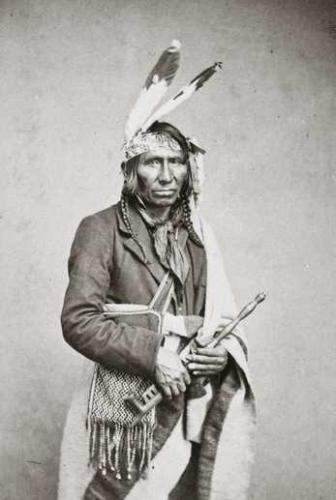
Iaweshowewekesik (Crossing the Sky), 1863. Iaweshowewekesik was a leader of the Gull and Rabbit Lake Ojibwe.

A few weeks ago fellow researcher Eliot Singer decided to collect and transcribe many relevant documents relating to the Grand Traverse region prior to the Civil War.   Amongst the treasures he found is a recently digitized slew of documents from the Commissioner of Indian Affairs.  Eliot has put forth a Hurculean effort with these transcriptions, bringing together many previously separate threads of stories, and the result is that we have a new perspective on a number of things, hence the title “The Plot Thickens”.

Most of you know that my major interest recently has been uncovering the history of Grove Hill School, and there is much here from Eliot to expand and enrich that story line.  There are references to official policies regarding instruction of Indian students in their native language which deserve to be investigated. Eliot also believes that there may be a connection between the publication of the 1856 Ojibwe Bible and the subsequent falling out between Dougherty and Peter Greensky, an observation which deserves more analysis.

So here is the opening salvo of observations from Eliot, which may serve as an introduction and guide to his Mission Period, Grand Traverse, Epistolary documents. Comments will be left open on this post, in the hope that we may generate a few ideas and discussions.
Mark Smith

cover photo: Iaweshowewekesik (Crossing the Sky), 1863. Iaweshowewekesik was a leader of the Gull and Rabbit Lake Ojibwe.

••••••••••••••••••••••••••••••

Some observations by Eliot Singer

A few months ago, I discovered the National Archive had finally digitalized many of the Commissioner of Indian Affairs microfilms of Agencies most relevant to Ojibwe (Chippewa) and Odaawaa. In the past, I have used the physical microfilms at the MSU library and found it too difficult to do more than copy short excerpts, except for a few items essential to my research. Now, with the luxury of sitting at my computer, enlarging, etc., I was able to browse, try to decipher, and transcribe. Around the same time, the Presbyterian Archive letters from Reverend Peter Dougherty became easily available.

            The result is that I became addicted to seeing how a number of story lines, some of which I was previously unaware, played out. So, I ended up transcribing and compiling extensively, mostly letters, hence the title Mission Period, Grand Traverse, Epistolary. My hope is people will first read it as a whole, like you would an epistolary novel, noticing all the intrigue, intertwining narratives, and character complexities.

            But of course, this is also a resource for further research and analysis. I have incorporated some of this material to cover the Mission period for an update to my analytical Oral and Witten Histories of Odaawaa and Chippewa Settlement of Northwest Michigan. There is also much that has me wondering, and I am sure there is more others will notice that I’ve missed. Just a few examples:

1) The published 1836 Treaty contains only the version amended by the Senate. Having access to the original, plus the “assent,” signed at Mackinac a few months later, is illuminating in many ways. I was intrigued to see one “Chieftainess” among the assent signatories. There are also some things that don’t make sense. I have doubts that the Oshawun Epenaysee who signed the treaty in Washington was really the minor chief, Shawun Epenaysee, probably within Akosa’s band, of Grand Traverse, rather than the major chief of Grand Island, otherwise missing. I believe the handwriting for the signatures is that of Augustin Hamlin, who would have known those from L’Arbre Croche well, but not necessarily others. This also raises the question of who gave the names (for this and other treaties). There was great reluctance to state personal names: “If a name has to be given, say to be put to some document, and the man is asked his name, he will not give it; but, after a long period of hesitation and embarrassment, he will indicate some other man who will tell his name” (Rev. Joseph Gilfillan, “The Ojibways of Minnesota,” Collections of the Historical Society of Minnesota, ix, 1901, pp. 111-112). If Hamlin (or Schoolcraft or Hulbert), only knew names second or third hand, mistakes would have been easy to make. There is also a very difficult to decipher signature for Grand Traverse, on the assent, beneath Aish Kwaygwonabee—“Nanens Ugomo [?]”—with Akosa missing. I wonder if this was alterative name for him, perhaps Ininiins Ogimaa (current orthography), Little-man Chief—he was referred to as “the young chief.”

2) Mark Smith and I have been trying to figure out more about Nagonabe, who was Chief of the Cat Head band when Reverend Smith visited in 1848 and became associated with Wakazooville. But there was no Cat Head band in 1839, and the only person with that name on that annuity list was a member of the Manistee band, of which Kewaygooscum was chief. Nagonabe had signed the 1836 assent, identified as from Grand Traverse. Reverend Smith noted for May 7, 1851: “Went to Nagonabes to see about the difficulty between him and Kewaguiskum—he said he did not know that Kewaquiskum struck him—perhaps he said he fell into the fire, he said he had no hard feelings toward him—he was not badly hurt…report says he is going to kill Kewaquiskum then he & his Band flee to Canada but he denies any evil intention.” In 1854 Nagonabe’s departure for Canada was one of the death blows to Wakazooville. Kewaquiskum must also have gone to Canada, because Smith’s entry for October 21, 1857, reads: “entered the selection of Kewaquiscum Chief of Manistee Band & 2 or 3 of his people   they have lately returned from Canada.” So, this is where historians sometimes need to speculate (speculations are not facts!). My speculation is that Nagonabe was the leader of a splinter faction of the Manistee Band and there was bad blood between him and the chief. Splits within bands, leading to the formation of new bands, were commonplace.

3) Enjoy the spat between the Johnstons and Dougherty (and his Presbyterian allies). Spoiler alert! William later sends his daughter (paying tuition) to Grove Hill. In the late 1850s, William, in need of a job, goes after his buddy Augustin Hamlin and his white wife, who did not speak “Indian,” was hired as a teacher.

4) Dougherty (virulently antagonistic to Papists) was moved from Old to New Mission in the Eagle, which I believe must be the schooner belonging to ardent Catholic, Peshabe. Despite chiefs and many others of Grand Traverse bands having signed a petition complaining of how, with their money, priests and ministers had bought land in their own names, apparently the first annuity funded purchase at New Mission (not just of mission property) was registered as by Walter Lowrie.

5) In 1856, a translation into Ojibwe of the entire New Testament was published. One impact seems to have been that Dougherty lost control of the message.

6) A. J. Blackbird took to using that as his official name. Folks at Grand Traverse knew him as Jackson Makaté-binési (modern orthography). He seems to have been the instigator behind petitions in the aftermath of the 1855 treaty seeking changes to education and was in need of a job.

The Story of Grove Hill School

The Story of Grove Hill School, updated March 2023

By Mark Smith, Omena Historical Society (for a pdf version of this essay click here)


Part One, Old Mission

The Early Days

This paper explores the history of Grove Hill School, the boarding school for local Odawa and Ojibwe people opened in Omena, or New Mission, in September 1853. (see note below text for naming conventions of indigenous peoples). Grove Hill School came into being when the first Protestant mission in the Grand Traverse area, founded by Reverend Peter Dougherty in the summer of 1838, moved their operations from Old Mission to the “New Mission” in Omena.  Dougherty was originally sent to the area by the Presbyterian Board of Foreign Missions (BFM) in 1838 and eventually settled on the Old Mission Peninsula, where he would remain to preach and teach until 1852. Funding for the education of the mission Anishinaabek by the Presbyterians was provided through government monies from the 1836 treaty settlement, in which the Indians gave up vast tracts of lands in exchange for a yearly annuity payment and provisions for implements, interpreters, blacksmiths, farmers and teachers.

It is important to note here at the outset that the Anishinabek of the Grand Traverse region were desirous to be educated, and particularly desirous to learn English, to know the law, remain in their homelands, and defend themselves in dealings with the sometimes rapacious white settlers of the area.  Reverend Dougherty’s school was seen as an asset to the community, and he was welcomed especially by Chief Aghosa, his main indigenous patron. Students attended Dougherty’s school of their own free will, encouraged by their parents.  Over time more Indians came to settle on “The Point”.

“The Protestant mission became an attraction of sorts to Anishinaabe communities, especially those near L’Arbre Croche, because the teacher taught in not only Anishinaabemowin, but also English.  The Austrian priests near Little Traverse Bay spoke little or no English, and the Indians wanted their children to speak English.” (Fletcher, 30)

Similarly, in 1852 Chief Peshawbe and his people moved from Cross Village to the Leelanau Peninsula, precisely to take advantage of being taught by the English-speaking instructors in the schools, which they deemed to be far more useful than learning from the German speaking priests in Cross Village. Education, especially in English, was seen as a positive force for self-improvement and tribal integrity at a time when the threat of removal was felt to be very real.

Also important to note here at the outset is the fact that the Anishinaabe desired to have trusted white settlers living nearby, in order to help mediate their dealings with the larger body of settlers.  During the 1836 Treaty negotiations in Washington the “chief speaker”, probably Aishquagonabe, speaking to Henry Schoolcraft, said:

“We fear that the whites who will not be our friends will come into our country and trouble us, and that we shall not be able to know where our possessions are, if we do sell our lands, it will be our wish that some of our white friends have lands among us and be associated with us. (Fletcher, 22)

Mainly these “white friends” were métis (mixed blood people), American citizens related through intermarriage who could mediate disputes with other American citizens, but benefactors like Reverend Dougherty also were seen as valued friends to be kept close at hand.

A last note pertains to agency.  From the above two paragraphs it may be assumed that the Indians saw themselves as being totally dependent on the grace and favor of members of the dominant white culture, with very limited options for self-determination and very little legal recourse.  However, the Odawa were anything but naïve or helpless.  Their alliances with certain members of the white community were strategic ways for them to adapt, persist and prosper in their own homelands.  “In 1841, Aghosa told Peter Dougherty that the Grand Traverse Anishinaabek ‘hold on to this place as a bird clings to a tree ready to fall.’” (Fletcher 38) Even though missionaries had varied luck in converting the Grand Traverse Indians to Christian farmers, the coming of the missionaries helped to make them “a group that, although still distinctly Indian, was yet able to adjust to and profit from the encroaching American economy.” (White, 10).

The historian James McClurken holds that the Anishinaabek were sophisticated in their enlistment of missionaries as allies in their attempts to avoid removal to west of the Mississippi:

“Ottawa people understood very well the process of making allies for their own benefit.  As part of their campaign to remain in Michigan, they made allies of those missionaries who opposed removal and supported Ottawa efforts to purchase land.  In the process, they learned that so long as they attended church services, the missionaries would help them build farms and supply them with food, clothing, and medicine.  Some Ottawa adults even went to the missionary schools to learn to read and write so they could conduct their own affairs in American society.” (McClurken, 29)

According to historian Susan Gray “The Ottawa … were far less interested in becoming like white men than in learning to live as Indians in the midst of white settlement.” (Gray, 83). So, despite relying on white benefactors, the Odawa were able to maintain their own traditions and prosper within the newly emerging onrush of white settlers, at least until they were swamped by white settlers after the civil war.

After carving out some acreage for building and cultivation, Dougherty’s mission (the “Old Mission”) grew and prospered.  In 1840 Reverend Dougherty ventured east to be married, returning with his new bride, Miss Maria Higgins (Sprague, and Smith). In the fall of that same year the young Andrew Blackbird was hired as apprentice blacksmith, a post he would keep for five years at a salary of $240 per year.  Many years later Blackbird would write that Dougherty “was indeed a true Christian, and good to the Indians” (Blackbird 55).

In 1842, with the help of the Indians, Dougherty began to build a manse and a mission church.  At the time the church was being built, Reverend Dougherty asked his congregation to make a financial contribution.  Their gift to Dougherty was a large quantity of copper pennies, which Dougherty sent off to a foundry, where the pennies were used to cast a bell for the church (Craker 62). (This bell travelled with the mission to Omena, to become the bell for the new church.)

By August of 1843 Dougherty would report that his school consisted of forty Indian and eleven white children, making a total of 51 students.  Basic “sounding out” and spelling were taught at first, as the building blocks of literacy.  Of the 51 students, “eight read correctly in their own and our language .. The others are learning the elements [alphabet], and spelling in words of one and two syllables.”  Dougherty admits to being disappointed that students did not attend more regularly but maintains that the capacity of the Indian students was “about on average” with that of the white children. In addition to the regular school, the Sabbath school regularly attracted 40 people, including Chief Aghosa, where the churchgoers were also taught to read “in their own language.. with a good degree of correctness.”  Also encouraging to Dougherty was the fact that drunkenness was down and industriousness was up, thanks to the effects of the church.  (Annual, 1843)

Many Roles

The work of Peter Dougherty entailed much more than preaching.  Dougherty advocated for his congregation in a variety of ways, including writing letters for them, helping them apply for land patents, traveling to Mackinaw with them to receive annuity payments, tending to medical needs, carpentry, gardening, animal husbandry and generally all the labors needed to survive and prosper in a remote wilderness.  From his congregation Dougherty earned the Anishinaabemowin nickname of Mic-koos, “little beaver”, reflecting his short stature and boundless energy (Craker 89).

In the early years the school averaged about 30 students, with great seasonal variations due to sickness, winter hunting, and maple syrup making.  Because the school was a day school, the students were more mobile (and attended less) than if they had been attending a boarding school.

Native Language

One reason for the popularity of Reverend Dougherty’s schools is that instruction took place in English, and parents recognized the advantages of learning the language of the dominant culture. In addition to teaching in English, Dougherty also encouraged the Indians to learn to speak and write in their own language.

Sometime during his other labors he managed to make significant contributions to the study of the local Indian language.  In the first years, the Upper Canadian Bible Society donated to his mission Ojibwa translations of the book of Genesis and the Gospel of John, but Dougherty soon produced books of his own.  In 1844 he published A Chippewa Primer, which Schoolcraft called “of much value to the philologist, as well as being adapted to promote the advance of the pupil. (Vogel 6)

With the help of interpreters Daniel Rodd and Peter Greensky, Reverend Dougherty published other books for his Anishinaabe students, including Short Reading Lessons in the Ojibwa Language (1847), a parallel text primer, and Easy Lessons in Scripture History in the Ojibwa Language (1847).

For Dougherty the primary goal of education was the “moral” aspect; by “moral” Reverend Dougherty referred primarily to the teaching of scripture, so it is not surprising that he valued the primer he wrote for his students, Easy Lessons in Scripture History in the Ojibwa Language. Truthfully, Dougherty, like most everyone of his time, took little interest in the world views of the Odawa.  He found no sense of irony in stating that “The Indian is very superstitious: he believes the Great Spirit has made him distinct from all others.” He criticized what he called the “heathen party” of unbelievers who resisted white culture:

His [the heathen Indian’s] country, his language, his customs, his religion, his medicine, his appetites and passions, are all the special bestowments of him who made him, and therefore they are best for the Indian. (Annual 1850)

Despite the somewhat condescending views in Dougherty’s assessment of indigenous culture, it is important to point out that Dougherty did not seek to actively eradicate the culture of the Anishinaabe, but he did seek to promote Christianity through bi-lingual teaching.  He was certain that, when presented with alternatives to their “heathen” lifestyle, the Indians would choose Christianity. When a new translation of the Ojibwa testament came out in 1859 Dougherty requested that the BFM purchase copies because “There is quite a demand for the Ojibwa testament.  It is studied more and understood better than before.” (Dougherty to Walter Lowrie, 16 Feb. 1859).  Far from seeking to eradicate the native language, Dougherty understood how to use that language to promote scripture and teach “proper” behavior. Incidentally, during America’s Civil War copies of this Ojibwa bible were found among captured Anishinaabe soldiers from the 1st Michigan Sharpshooters of Company K, evidence of the importance of scripture to those soldiers and evidence of Reverend Dougherty’s influence. (Cassidy, “Both..)
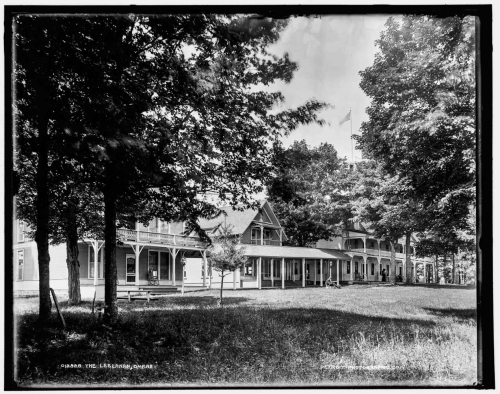
The Grove School, converted to the Hotel Leelanau

Here it is important to note an essential distinction: when the first government-run boarding schools later opened in the late 1860’s, the policy was almost always the suppression and prohibition of native languages in the schools with the goal of eradicating all ties to parents and indigenous culture.  This brute force approach was seen as the best way to rapidly “civilize” the native people. Contrary to this philosophy of language suppression, Dougherty believed in the benefits of bilingualism.

In addition to their English studies, both schools [male and female] should be taught to read their own language.  It is found here, as at other missions, that this does not interfere with their regular lessons in English, and it is an acquisition both pleasing and useful to their parents. (Annual 1850)

Note the inclusion of parents which continued to be a feature of the Dougherty philosophy at Grove Hill School in Omena.

Over time most of the families had taken up residence in the immediate vicinity of the old mission and worked tirelessly to produce a surplus of food.  By 1847 Dougherty would write:

Six years ago the site occupied by the village was a dense thicket.  The village now extends nearly a mile in length, containing some twenty log houses and some good log stables belonging to the Indians. During that period they have cleared and cultivated some two hundred acres of new gardens, besides what additions were made to the old ones.  They raise for sale several hundred bushels of corn and potatoes. (Garritt 6)

Despite tremendous difficulties, and despite many setbacks and challenges, it is fair to say that Dougherty’s mission was a success.  The influence of drink provided by the growing population of white settlers remained a serious issue, but all in all the mission prospered and grew.  However, the land at Old Mission, having been set aside as a reservation, did not belong to the Anishinaabek of the mission.  All the improvements made to the mission would be lost if the land could not be purchased and secured for those who had made the improvements. With white settlers flocking to the area to buy land, their future was uncertain.

During this time the Anishinaabek of Michigan were constantly under threat of removal to territory west of the Mississippi, a fate they desperately hoped to avoid. The goal was to find a way to stay put. The second constitution of Michigan in 1850 provided an enhanced chance for the Anishinaabek to remain.  Under the provisions of the 1850 Michigan Constitution, Indians who had renounced tribal affiliations could become citizens of the state, with full voting rights (Karamanski 130). If the Indians could secure a title to some land, and if they were deemed citizens of Michigan, they would feel less threatened by removal. Unfortunately, the lands at Old Mission were not offered for immediate sale.  But land on the Leelanau peninsula had recently been made available for general purchase.  Gradually the Anishinaabek of Old Mission began buying up parcels and relocating to the Leelanau Peninsula, in the environs of present day Omena, where Reverend Dougherty would relocate his New Mission in 1852.

  • ••••••••••••••

Part Two, Omena

Finding Workers

The establishment of a manual training boarding school for Anishinaabek

in Omena did not take place without extensive planning.  Even before the move from a day school in Old Mission to a boarding school at the New Mission, Reverend Dougherty expressed his approval of the idea in principle but warned that in order to succeed, the mission would need to rely on “the labors of pious laymen and their wives; … suitable teachers, male and female; farmers; and families to take the charge of the boarding department” primarily because “Much precious time of the missionaries is taken up with labors that could be better performed by others” (Annual 1849).  This would be a recurring theme with Dougherty over the following years as he saw his efforts increasingly devoted to working long, arduous hours of manual labor to maintain the mission, at the expense of his primary job of ministering to his flock. Dougherty rightly foresaw that running a boarding school would be a much bigger task than running a day school.

Dougherty’s warnings here can be seen as a report “from the trenches” to his superiors, who perhaps could not begin to imagine the hardships of the task. Compared to his brethren ministers out east, who were preaching on Sunday and ministering during the week, Dougherty found himself chief cook and bottle washer in a remote outpost, working long, hard hours.  He described the hardships of

The separation from beloved relatives and friends, the unavoidable absence of many comforts which abound in civilized communities, the limited circle of their Christian community, the apathy, in many cases, of the benighted natives, the many, many days of teaching, and instruction, that must be endured, by our beloved brethren and sisters, in these labors of love and mercy. (Annual 1853)

However, despite Dougherty’s complaints about being constantly short staffed, he persevered.

The School Begins

Reverend Dougherty was opposed to bringing his log schoolhouse from Old Mission over to Omena (as suggested by the BFM) because he felt that the log structures did not indicate permanence to his congregation, and moreover they were not easy to heat and maintain (Dougherty, Letter to Lowrie, Sept 13th, 1851). He insisted on the construction of a new building at Grove Hill, had to advocate strongly for it, and was heavily involved in the planning and construction of it.  The building at Grove Hill was meant as an assurance of commitment to permanent and long-lasting support for the whole community, children and parents.

Grove Hill School went into operation in September of 1853 with twenty boys and nine girls, and the number increased over the next year to 20 girls and 28 boys. The school was designed to accommodate 50 to 60 people, including students, workers, teachers and families.  The school proved to be so popular with parents that it was soon at peak enrollment, with a waiting list for new applicants.

By 1853 Grove Hill had 20 acres under cultivation. A teacher provided agricultural training for the boys and the garden produced food to supply the mission through the winter.  In order to inculcate “habits of industry” the school kept to a rigorous schedule all year round. In his first annual report from Grove Hill to Indian Agent Henry Gilbert, Dougherty described the daily regime:

The regulations of the Institution are as follows.  Rise in summer at half past four and in winter at 5 o’clock am. Prayers half past five & six, breakfast at six and half past six, in summer & winter respectively.  Work from breakfast to half past eight, school at nine, dinner at twelve, school at half past one, work from half past four to six, supper at six, prayers at eight pm.  then the children go to bed. (Annual 1854)

Academic subjects taught at the school included reading, writing, arithmetic, geography, grammar, and philosophy.  Boys also worked outdoors in the garden and girls also were instructed in “domestic labor and economy” (Annual 1854). Although by modern standards the regime of the school seems unnecessarily strict and regimented, it is important to remember that, as L. P. Hartley said “The past is a foreign country: they do things differently there.”  By modern day standards some may judge that the school was unnecessarily harsh, but in fact the strict regime was typical of other boarding schools of its time.  The school was strict, but not cruel.  A more salient criticism may be that of ethnocentrism, but again, it must be remembered that this was a Presbyterian school and typical of its time. We may bemoan the lack of interest in honoring native culture at the school, but we cannot expect Reverend Dougherty to behave like a man existing out of time.

Parental Inclusion

Unlike the government-run boarding schools which started up after the civil war, Dougherty’s Grove Hill School encouraged parents to visit and to be involved.  The hope was that by educating the children the parents also would be lifted up. Dougherty was well aware that some Native parents were against having their children educated:

Education arms the vicious with increased power to do evil; and the minds of the Indians have often been prejudiced against the education of their children, by seeing those who had enjoyed its advantages becoming wiser only to do evil. (Annual 1850)

He rightly saw that if the Odawa were to stand a chance against the steady stream of white settlers who were rapidly flooding into the area, the native families must be helped through education:

Again: these schools are a most important and powerful agency for good, not only to the youth and children but to their parents. Instruction in these communities, to meet their wants, must be on a comprehensive scale.  The white population is closing round them on every side, and everything should be done to enable them to stand side by side with their white neighbors. (Annual 1850)

Dougherty believed that the school needed to be enmeshed in the settlement because parents needed to be able to see for themselves how the school was run.  Grove Hill School was open to all visitors.

To keep his flock together and protected from the sharp dealings of the white settlers, Dougherty knew it was necessary to train his students and their families in the ways of the dominant white culture.  Dougherty knew that if his students were to attend a white school (where they would probably be singled out and ridiculed) they would not fare as well as if they were taught in their own setting.  They lived mainly north of the school, in nearby Aghosatown. Reverend Dougherty tried to keep them close together but almost as soon as his congregation began to settle in the Omena area they started to disburse, “some choosing one place, and some another, and thus their position for the future is quite uncertain” (Annual 1851). A well-known disadvantage of the day school at Old Mission was that students were taken out whenever their parents removed to sugar camps or winter hunting grounds.  The boarding school at New Mission would help address this problem, as well as the general disbursement problem of families living too far away to attend a day school.  Parents were central to Dougherty’s philosophy.

Our efforts ought to regard these people as a whole and the influences which are brought to bear on them ought to reach the adults as well as the children and effect family as well as individual improvement.  We are therefore very fully of the view that the mission must be in the neighborhood of the Indian Settlement.”  (Dougherty, Letter to Walter Lowrie, July 30th, 1851)

The Later Years

Grove Hill School grew and prospered.  For many years it was the center of learning and a place for numerous visitors and meetings, but by the time of the Civil War it was running at a loss.  The gradual dispersal and scattering of Reverend Dougherty’s flock led eventually to the demise of the school.  As early as 1858 Dougherty sensed that the mission would be difficult to maintain, financially, and in 1866 the BFM instructed Dougherty to sell the school, leaving only the church and associated mission. The church was kept open for another 5 years, but attendance continued to dwindle; by 1870 the writing was on the wall and in 1871 the BFM closed both the Omena and the Bear River outstation. “The organization’s precarious financial status did not allow it to continue supporting Indian missions without Indians” (Devens 107).

Dougherty’s last letters to the Corresponding Secretary of the Presbyterian Board of Foreign Missions have an air of resignation and sadness.  His friend Walter Lowrie, the previous Corresponding Secretary, died in December 1868, but Dougherty continued writing to his son, John C. Lowrie. In an undated letter from this time Reverend Dougherty looks back over 20 years and opines:

“But little change, in the aspect of things, has taken place, during the past year, except the shadows in the horizon of hope have a darker hue, and the mind as it contemplates them is less buoyant and confident, and looks to the future with a feeling of sadness.” (Dougherty 1870)

Dougherty had hoped that his mission would be a shining example of the benefits of the gospel, a civilizing influence on his flock, and a bulwark against White encroachment, but found in the end that “Intemperance is our greatest trouble and their great besetting sin” and that “As white men settle in around them the facilities and temptations to indulgence increase, and they are yielding more and more every year to these influences” (Dougherty 1870).

In 1871 Reverend Dougherty writes his last sad letter from Omena, indicating that the members of his church “feel uncomfortable about our proposed removal” and that they “offered to contribute of their means to aid in our support.”   Dougherty explained that

“it was not want of support that led us to think of removing and leaving them, but the circumstances of our family growing up isolated so that they have no fair opportunity for occupation or settlement in life.  They appreciate the motive.  While duty to our family seems to direct us away it is painful to leave home for those for whom our lives have chiefly been spent to be scattered after we have labored so long to gather them.” (Dougherty to J. C. Lowrie, Feb. 10, 1871)

When the church in Old Mission was first built, the Indians gathered up all the pennies they had been saving and gave them to Reverend Dougherty to make a bell for their church.  That bell was brought over to Omena in 1853. As Dougherty signs off for the last time, he mentions the bell in closing: “In the church is the bell and two stoves which belong to the board but I suppose they remain for the use of the Indians as long as they need them.” (Dougherty to J. C. Lowrie, Feb. 10, 1871)

After the mission was closed, the church was only sporadically opened to preaching.  Occasionally Reverend George Nelson Smith from Northport would come to preach, and Alonzo Barnard also preached until 1880.  By 1885 a Congregational Church was organized in Omena and the local Presbyterians joined the Congregationalists in the church (Craker).  Today the church still stands proudly on the hill leading out of town.  Grove Hill School was sold in 1868 and by 1885 was opened as the Hotel Leelanau, an upscale resort destination for summer residents.  It was shut down in 1917 and torn down in 1929 (Holmes).  Apart from a few bricks and blocks hidden in the deep weeds, nothing remains to indicate the existence of Grove Hill School.

(for a pdf version of the Power Point presentation which accompanies this essay, click here)

  • •••••••••••••

(Note: the term “Anishinaabek” or Anishinaabeg refers to several groups of indigenous peoples, including the Odawa and Ojibwe who feature in this paper.  “Anishinaabe” is adjectival. “Anishinaabemowin” designates the language spoken. The term “Indian”, although distasteful to some, was the designation used at the time of this story and indeed the term still used by many Anishinaabek themselves.  The Grand Traverse Band of Ottawa and Chippewa Indians, for example, is still the standard nomenclature.)


Works Cited

Annual Report of the Board of Foreign Missions of the Presbyterian Church of the United States of America. United States, n.p, 1929.

Blackbird, Andrew J. History of the Ottawa and Chippewa Indians of Michigan: A Grammar of Their Language, and Personal and Family History of the Author. Petoskey, Mich: Little Traverse Regional Historical Society, 1970.

Cassidy. Michelle. “The More Noise They Make: Odawa and Ojibwe Encounters with American Missionaries in Northern Michigan, 1837-1871.”  Michigan Historical Review, vol. 38, no. 2, Central Michigan University, 2012, pp. 1–34.

Cassidy, Michelle K. “Both the Honor and the Profit”: Anishinaabe Warriors, Soldiers, and Veterans from Pontiac’s War through the Civil War.” https://hdl.handle.net/2027.42/133496

Craker, Ruth. First Protestant Mission in the Grand Traverse Region. Rivercrest House, 1979.

Dougherty, Peter, “Dougherty Papers,” 1838-1872, Presbyterian Historical Society, online.

Devens, Carol. Countering Colonization, Native American Women and Great Lakes Missions, 1630-1900.

Fletcher, Matthew. The Eagle Returns. Michigan State University Press, 2012.

Garritt, Joshua Bolles. Historical sketch of the missions among the North American Indians : under the care of the Board of foreign missions of the Presbyterian Church, Philadelphia: Women’s Foreign Missionary Society of the Presbyterian Church, 1881.

Gray, Susan E. “Limits and Possibilities: White-Indian Relations in Western Michigan in the Era of Removal.” Michigan Historical Review 20 (1994): 71-91.

Holmes, Amanda. Omena a Place in Time a Sesquicentennial History 1852–2002. 1st., The Omena Historical Society, 2003.

Karamanski, Theodore J. Blackbird’s Song. Michigan State University Press, 2012.

McClurken, James M. “The Ottawa.” In People of the Three Fires: The Ottawa,
Potawatomi, and Ojibway of Michigan.
Grand Rapids: Intertribal Council of
Michigan, 1986.

Singer, Eliot, “Mission Period, Grand Traverse, Epistolary,” Ethno and Superior
History, picaresquescholar.wordpress.com, accessed February 2023.

Smith Family papers (H02-1465.50), The Joint Archives of Holland, Hope College, Holland, MI.

Sprague, Elvin Lyons, and Seddie Powers Smith. Sprague’s History Of Grand Traverse And Leelanaw Counties, Michigan. B.F. Bowen, 1903.

Vogel, Virgil V.  “The Missionary as Acculturation Agent.” Michigan History, vol. 51, no. 3, 1967.

White, Richard. “Ethnohistorical Report on the Grand Traverse Ottawas.” Unpublished manuscript, 1991.